
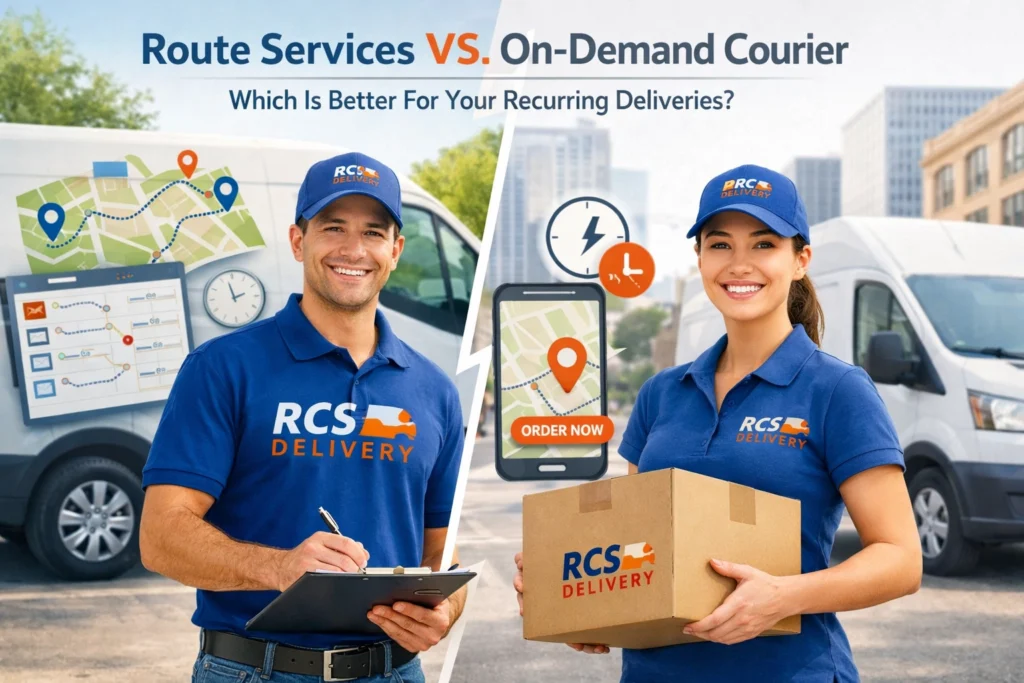
If your business ships the same stuff, to the same places, on the same schedule, you’ve probably asked this question at least once:
Do you stick with on-demand courier orders… or switch to a scheduled route service?
Here’s the deal: both are useful. But for recurring deliveries, one usually wins on cost, consistency, and sanity.
Let’s break it down together, plain English, no fluff, and with real-world examples from industries like healthcare, banking, legal, and retail.
Table of contents 🧭
- Quick definitions (route vs. on-demand)
- What “recurring deliveries” really means
- Route services: the big advantages
- On-demand courier: when it shines
- Side-by-side comparison (simple table)
- Industry scenarios (medical, bank/legal, business ops)
- How to choose the right model (decision checklist)
- Best practice: mixing both for maximum control
- How RCS Delivery supports both options
1) Quick definitions (so we’re on the same page) ✅
Route service (scheduled courier)
A route is a pre-planned, recurring delivery schedule.
Think:
- “Every weekday at 10:00 AM”
- “Twice daily pickups”
- “Every Monday/Wednesday/Friday”
- “Same stops, same order, same expectations”
Route delivery is built for routine.
Want to see what that looks like? Here’s our route page: https://rcsdelivery.com/route-service
On-demand courier
An on-demand courier is dispatched when you place an order.
Think:
- “ASAP pickup”
- “We need this there today”
- “Emergency run”
- “Not sure when we’ll need it, but we might”
On-demand is built for flexibility.
And yes, this includes same day delivery service needs when the schedule can’t wait: https://rcsdelivery.com/same-day-delivery
2) What counts as “recurring deliveries”? 🔁
Recurring deliveries are any shipments that happen on a predictable rhythm.
Common examples:
- Daily specimen transport from clinic to lab
- Regular bank branch runs for deposits, checks, or internal mail
- Court filings and legal document drops on set deadlines
- Interoffice mail pickup and drop-off
- Retail restocks between locations
- Scheduled warehouse-to-store transfers
If you’re repeating the same delivery pattern week after week, you’re in route territory, even if you’ve been ordering it “on-demand” out of habit!
3) Route services: why they usually win for recurring work 🚚
Let’s dive into the biggest wins you get when you move recurring deliveries onto a route.
Benefit #1: Predictability you can actually plan around
When your pickups and drop-offs happen at consistent times, everything downstream becomes easier:
- Staffing
- Customer expectations
- Prep work
- Internal handoffs
- Compliance documentation
You’re not wondering “When will the courier arrive?” every day.
You already know.
“For recurring logistics, predictability is a performance metric. If your operation relies on timing, a scheduled route is how you protect it.”
, Dana Howell, Logistics Operations Consultant (Healthcare & Retail)
Benefit #2: Better cost-per-stop over time
Here’s the deal: on-demand deliveries often come with a premium because they’re flexible and can be urgent.
Routes, on the other hand, allow a courier company to:
- plan stops efficiently
- minimize dead miles
- consolidate work
- keep your pricing stable
That typically means lower cost per stop as your route matures.
If you’re doing recurring deliveries, those savings add up fast.
Benefit #3: Consistent driver familiarity (huge for secure handoffs)
For industries like healthcare and finance, the handoff matters.
With a route:
- the same driver often services the same locations
- your team knows who’s coming
- access and sign-in routines get smoother
- fewer mistakes happen at the door
This is especially valuable for secure courier services where chain-of-custody, identity checks, and controlled access are part of the daily workflow.
Benefit #4: Easier auditing and performance tracking
Scheduled routes make it simpler to track:
- on-time performance
- stop completion
- recurring exceptions (“this location always needs a call first”)
- proof-of-delivery patterns
And if you want visibility, you can use tracking tools to keep everyone aligned: https://rcsdelivery.com/order-tracking
Benefit #5: Operational calm (yes, that’s a thing!)
No one talks about the mental load of constant “order, confirm, coordinate, repeat.”
Routes remove a lot of that daily friction.
And that means fewer last-minute emails, fewer internal pings, and fewer surprises.
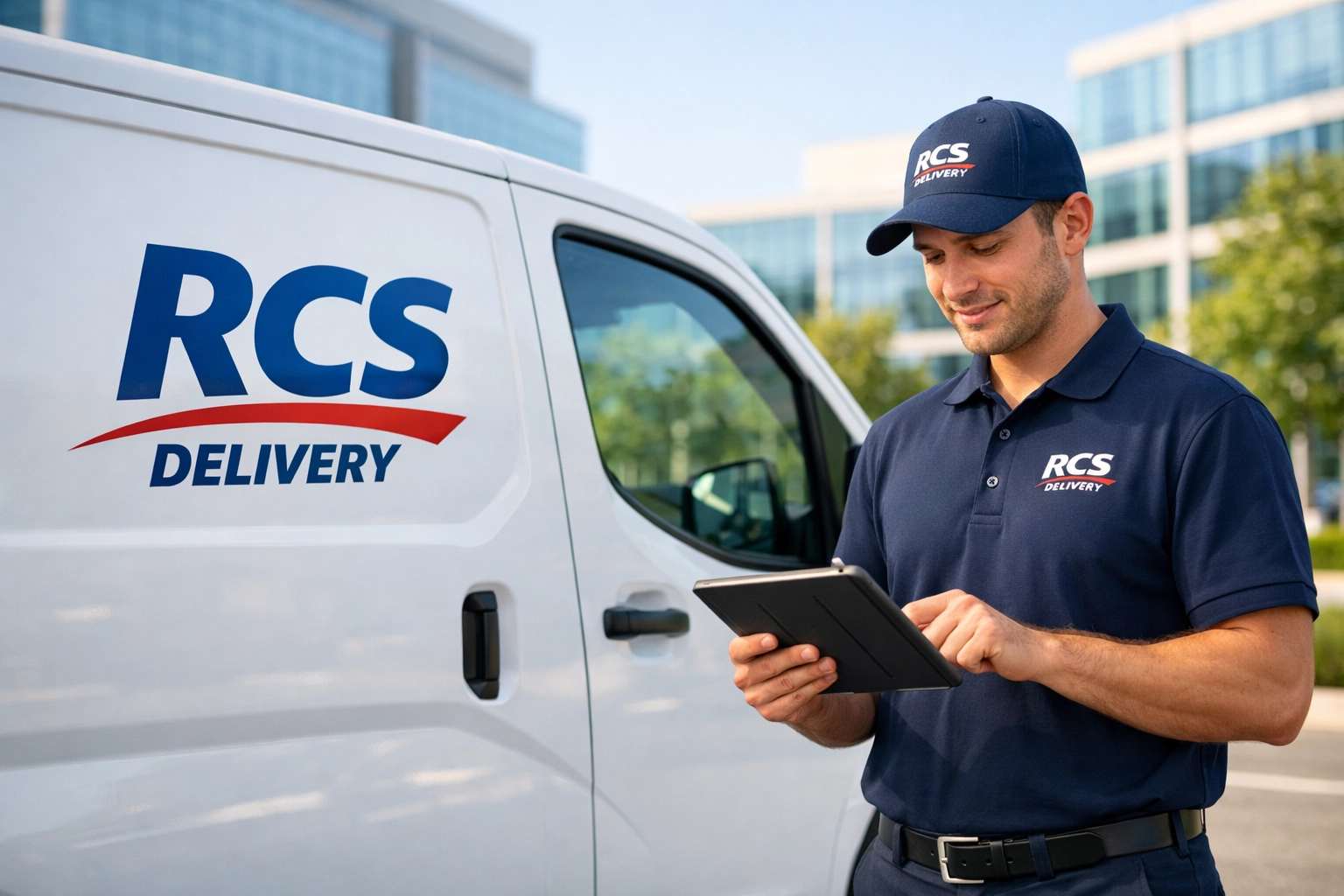
Image suggestion: A branded RCS Delivery route vehicle with the official RCS Delivery logo on the door, plus a driver in uniform with the logo on hat and shirt, checking a stop list on a tablet.
4) On-demand courier: when it’s the right call ⚡
On-demand is not the “bad option.” Not even close.
It’s the right tool when your deliveries aren’t consistent, or when something urgent pops up.
Use on-demand when you need:
A) True urgency
- missed cutoff times
- last-minute document signing
- STAT medical shipments
- unexpected replacement parts
That’s the classic same day delivery service scenario.
B) Variable volume
If your delivery needs change by the hour or season:
- promo events
- unpredictable patient volume
- legal discovery spikes
- end-of-month banking surges
On-demand lets you scale up and down.
C) One-off specialty runs
Some deliveries are too unique to “route”:
- special handling
- high-value items
- unusual access requirements
- out-of-area destinations
5) Route vs. On-demand: simple side-by-side 📊
| Category | Route Service | On-Demand Courier |
|---|---|---|
| Best for | Recurring, scheduled deliveries | Urgent, irregular, unpredictable runs |
| Cost structure | Typically lower cost per stop over time | Often premium pricing for flexibility |
| Scheduling | Fixed windows and recurring cadence | As-needed dispatch |
| Reliability | High (planned and consistent) | High, but depends on real-time demand |
| Driver familiarity | Often consistent | Varies by availability |
| Ideal for | Labs, banks, offices, daily ops | Emergencies, spikes, one-offs |
6) Real-world scenarios (by industry) 🧩
A) Healthcare & labs: when route service is the move 🧪
If you’re moving specimens, supplies, or reports regularly, a scheduled route is usually the cleanest solution.
A route is especially helpful for:
- daily clinic-to-lab transport
- multi-stop pickups across multiple practices
- timed drop-offs aligned with lab processing windows
That’s where a dedicated medical courier service approach shines.
Related service info: https://rcsdelivery.com/laboratory-services
“In lab logistics, timing isn’t just convenience, it affects processing and downstream decisions. Routes reduce variability, which reduces risk.”
, Marcus Lee, Laboratory Logistics Manager
B) Banking & legal: secure transport with predictable windows 🏦⚖️
If you’re handling sensitive materials, financial documents, checks, legal filings, you want:
- consistent procedures
- known pickup windows
- repeatable chain-of-custody habits
Routes help you build a dependable rhythm, and on-demand fills gaps when something is urgent.
If your team needs a dedicated bank courier service, you’ll generally benefit from a hybrid setup:
- route for daily/weekly runs
- on-demand for exceptions
Bank service page: https://rcsdelivery.com/bank-delivery-service
Legal documents page: https://rcsdelivery.com/legal-documents
C) Business operations: mail runs, interoffice, supply loops 📬
Many businesses don’t realize they’re basically running a route already.
If you do:
- daily mail pickup drop-off
- office-to-warehouse transfers
- recurring vendor drop-offs
…you’re a great fit for route optimization.
Mail services: https://rcsdelivery.com/mail-pickup-drop-off
7) How to choose: a quick decision checklist ✅
Ask yourself these questions (and be honest!):
Go with a route service if:
- You have deliveries 3+ days per week
- Stops are repeatable
- Timing matters (open/close windows, processing times)
- You want predictable costs
- You want fewer daily dispatch tasks
Go with on-demand if:
- Your volume is unpredictable
- You need emergency response capability
- Delivery locations change constantly
- You’re testing a new workflow before committing to a schedule
Still unsure? Use this quick rule:
If you can predict it on a calendar, route it.
If you can’t, dispatch it.
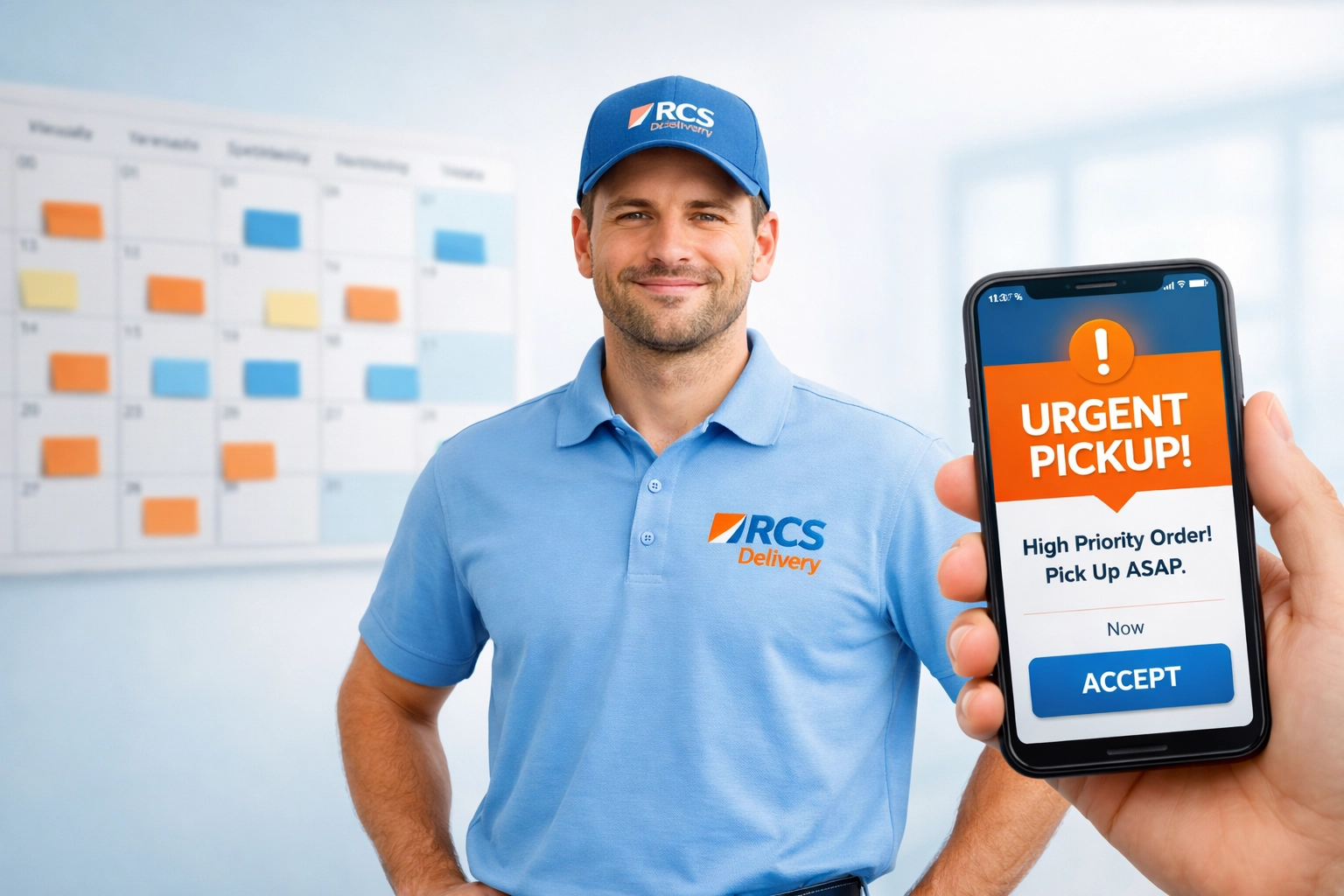
Image suggestion: A simple visual of a weekly calendar labeled “Route Stops” vs. a phone with “On-Demand Request,” with an RCS Delivery courier in logo-branded uniform in the center.
8) Best practice: mix both (route for the routine, on-demand for the curveballs) 🔄
Most high-performing delivery operations don’t choose only one.
They do this:
- Routes cover the recurring baseline (the stuff you know will happen)
- On-demand covers exceptions (the stuff you hope won’t happen)
This hybrid model gives you:
- stable costs where possible
- fast response when necessary
- less chaos overall
- better service consistency for your customers
And yes, it’s a common setup for:
- medical + lab networks
- legal firms with filing deadlines
- banks with end-of-day cutoffs
- multi-location businesses
9) Where RCS Delivery fits in (and how to get started) 🤝
At RCS Delivery, we help businesses build delivery plans that are practical, reliable, and easy to manage.
That includes:
- scheduled route services for recurring deliveries
- same day delivery service options for urgent shipments
- professional courier support for secure, high-touch handoffs: https://rcsdelivery.com/professional-courier
If you’re running recurring stops and want to explore a route setup (or a hybrid plan), reach out here: https://rcsdelivery.com/contact-us
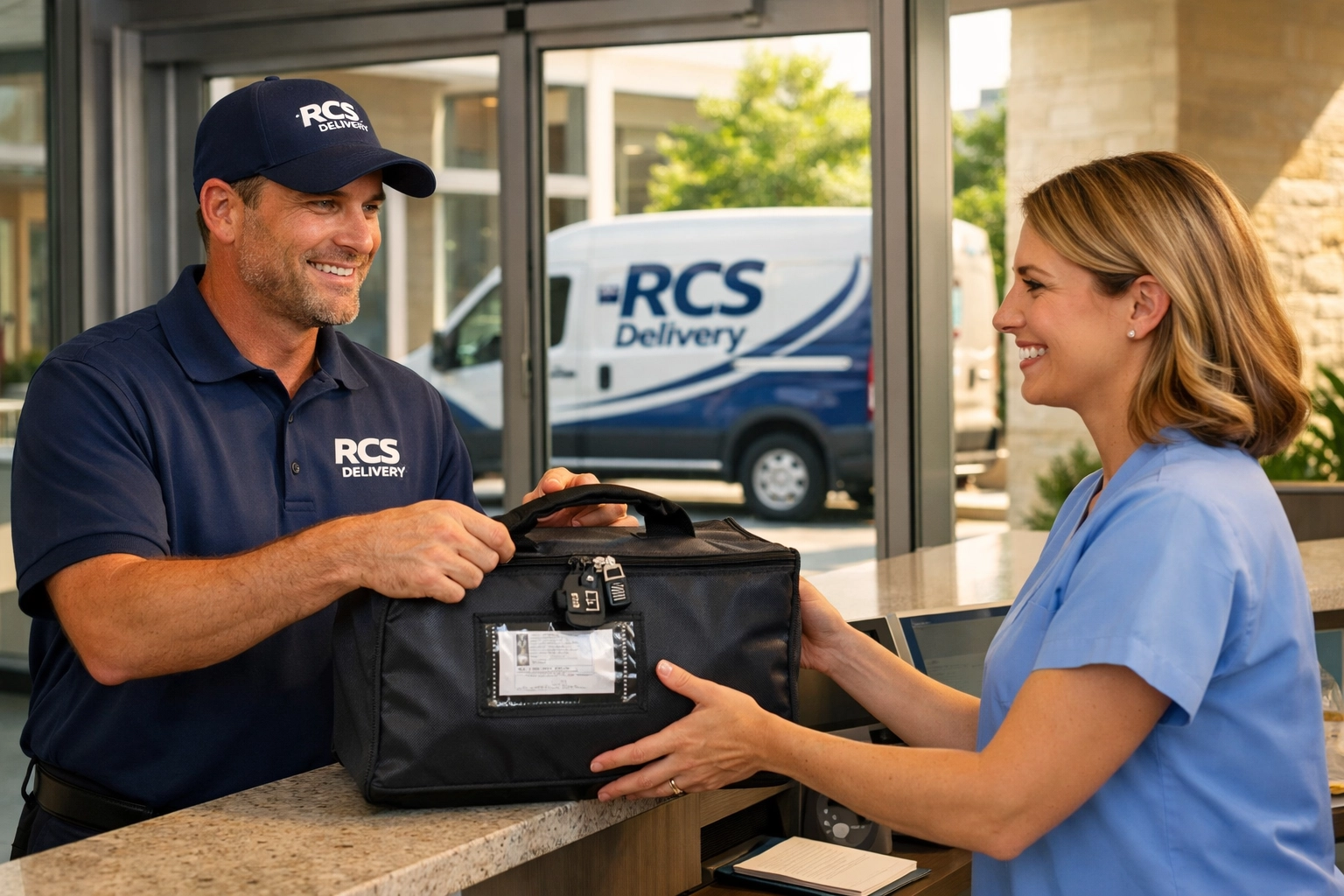
Image suggestion: A branded RCS Delivery van (logo clearly visible) parked at a business entrance while a uniformed courier (logo on hat and shirt) obtains a signature on a clipboard: emphasizing reliability and proof-of-delivery.